






























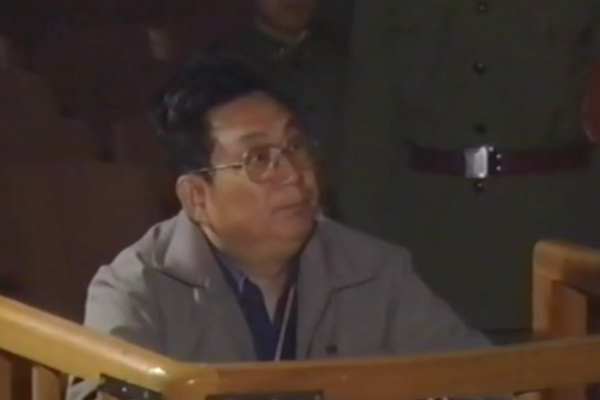
A remarkable six-hour recording has emerged from the shadows of Chinese history, revealing the previously unseen military trial of Major General Xu Qinxian—the high-ranking officer who defied orders to deploy troops against pro-democracy protesters during the 1989 Tiananmen Square demonstrations.

The extraordinary footage, shared on November 24 by Chinese scholar and Tiananmen protest participant Wu Renhua, documents the secret trial proceedings from March 17, 1990. The video, now hosted on YouTube by Human Rights in China after being removed from the Internet Archive, provides an unprecedented glimpse into one of the most sensitive episodes from that turbulent period in Chinese history.
Xu Qinxian commanded the People’s Liberation Army’s 38th Group Army, considered among the military’s most elite units. His refusal to sign deployment orders shocked the Communist Party’s top leadership, including then-paramount leader Deng Xiaoping and President Yang Shangkun, who had expected unquestioning compliance from their military commanders.
The crisis began when Chinese authorities declared martial law on May 20, 1989, as massive pro-democracy demonstrations swept across Beijing and other major cities. When military officials convened to deliver the deployment order, Xu stunned his superiors by refusing to comply. The PLA ultimately entered the capital approximately two weeks later, opening fire on civilians during the tragic events of June 3-4.
Behind Closed Doors: A Trial Shrouded in Secrecy
The leaked video captures the closed-door military court proceedings in Beijing, where prosecutors repeatedly denounced the student-led democracy movement and accused Xu of “openly opposing the CCP Central Committee.” Throughout the lengthy proceedings, the general maintained remarkable composure, displaying a calm and measured demeanor that contrasted sharply with the gravity of his situation.
The presiding judge explicitly stated that the trial was conducted in secret because the case involved state secrets—a designation that has kept operational details of the 1989 military response highly classified in China to this day.
Xu faced charges of “defying martial law orders,” but his testimony revealed the moral struggle behind his decision. Recounting the moment he received orders to deploy troops on Beijing’s streets, he told the court he sought clarification about the operation’s scope and weaponry involved. The general expressed skepticism when informed that armored vehicles and heavy machine guns would be deployed against civilians.
“I said [to my superiors] I have a different opinion on the matter,” Xu testified. “This was a civilian political movement, which should be resolved politically. If force is required, it should be just the Secret Service, police, and SWAT. That’s enough. If troops really have to be mobilized, I suggested moving the troops close to Beijing, as a deterrent.”
The general went further, recommending that China’s highest governing bodies—the Standing Committee of the National People’s Congress, the State Council, and the Central Military Commission—convene to discuss the momentous decision.
Justice Without Due Process
The trial proceedings revealed the limitations of China’s judicial system under Communist Party rule. The court appeared to follow a predetermined script, with judges spending nearly half the video reading “witness statements” against Xu. Notably, these witnesses never appeared in court, and no cross-examination took place.
Xu faced the proceedings largely alone, without legal representation sitting beside him. A state-appointed public defender sat separately and made only minimal contributions throughout the trial, forcing the general to mount his own defense.
“Is it a mistake or a crime? I believe the court will make a judgment based on the facts,” Xu stated during his final remarks to the court.
The leaked recording ends abruptly during the public defender’s comments following Xu’s statement, omitting the actual sentencing. Beijing-based independent journalist Gao Yu later revealed that Xu was imprisoned in Qincheng Prison’s 203rd section, housed alongside other high-profile political prisoners.
A Hero’s Legacy Emerges
The video’s release has generated intense discussion among Chinese-speaking communities outside mainland China, where Tiananmen Square remains a forbidden topic. Many viewers have praised Xu as a principled officer who refused to participate in violence against civilians, noting that his warnings about the political and historical consequences of military action proved remarkably prescient.
According to Wu Renhua’s research, Xu was receiving medical treatment in a Beijing military hospital during the 1989 protests, giving him firsthand exposure to the scale and motivations of the student-led movement. When the Beijing Military Region announced the martial law deployment order on May 17, 1989—signed by Deng Xiaoping and Yang Shangkun but notably refused by then-General Secretary Zhao Ziyang—Xu made his fateful decision to decline leading his troops into the capital.
The consequences were swift and severe. Immediately after his defiance, Xu was dismissed from his command and arrested by the PLA General Political Department’s security unit. The military court sentenced him to five years in prison, which he served in Qincheng Prison before being relocated to Shijiazhuang in Hebei Province.
Meanwhile, Zhao Ziyang, who had chosen dialogue over force with the protesting students, was removed from power after the June 4 massacre and placed under house arrest for the remainder of his life.
Xu Qinxian died on January 8, 2021, at age 86, having lived most of his final decades in relative obscurity. The emergence of this secret trial footage, however, ensures that his courageous stand against orders to fire on civilians will be remembered as a powerful testament to individual conscience in the face of authoritarian pressure.
The video’s preservation and eventual release raise intriguing questions about how such sensitive material survived China’s extensive surveillance and censorship apparatus. For many observers, its appearance serves as a reminder that even the most closely guarded secrets of authoritarian regimes may eventually come to light, offering future generations a clearer picture of pivotal moments in history.