







































In a strategic move to address growing maritime security concerns, Japan has announced significant aid packages for South American nations struggling with China’s illegal fishing activities in their territorial waters. This development comes as the Chinese Communist Party continues its aggressive expansion of influence throughout the region.

The initiative represents a coordinated international response to what experts describe as systematic violations of maritime sovereignty by Chinese vessels operating far from their home waters. China currently maintains the world’s largest distant-water fishing fleet, which has drawn increasing scrutiny from maritime security analysts and affected nations alike.
Maritime security experts speaking to The Epoch Times emphasized that Japan’s intervention signals a broader coalition forming to address the multifaceted threats posed by Chinese fishing operations. These activities extend far beyond simple overfishing, encompassing intelligence collection for military purposes and what security professionals term “gray zone” operations – actions that fall below the threshold of direct military confrontation while still advancing strategic objectives.
The scope of China’s distant-water fishing operations has reached unprecedented levels, with vessels routinely documented in the exclusive economic zones of South American countries. These incursions not only deplete local fish stocks but also undermine the economic foundations of coastal communities that have depended on fishing for generations.
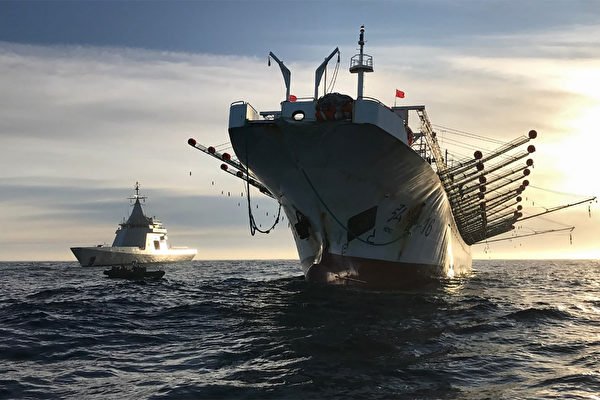
Photographic evidence from Argentina’s Navy Press Office dramatically illustrates the problem, showing Chinese fishing vessels operating illegally within Argentina’s exclusive economic zone as recently as May 2020. Such documented violations have become increasingly common across South American waters, prompting regional governments to seek international assistance in protecting their maritime resources.
The intelligence-gathering aspect of these fishing operations has particularly concerned security analysts. Chinese vessels operating under the guise of commercial fishing have been observed conducting activities inconsistent with legitimate fishing operations, raising questions about dual-use capabilities and information collection in sensitive maritime areas.
Japan’s aid initiative comes at a critical juncture as South American nations face mounting pressure on multiple fronts. The depletion of fish stocks affects not only commercial fishing operations but also subsistence fishing communities whose traditional way of life faces unprecedented challenges from foreign industrial-scale operations.
The coordination between Japan and South American countries represents a significant diplomatic development in the broader context of great power competition in the region. As China has expanded its economic and political influence through infrastructure investments and trade agreements, other major powers are now taking more active roles in supporting regional sovereignty and security.
Maritime law experts note that the exclusive economic zones of coastal nations extend 200 nautical miles from their shores, granting them sovereign rights over natural resources within these waters. The systematic violation of these internationally recognized boundaries by Chinese vessels represents a clear challenge to established maritime law and the economic rights of affected nations.
The environmental impact of illegal fishing operations extends beyond immediate resource depletion. Unregulated fishing practices can disrupt marine ecosystems, affect breeding cycles of fish populations, and cause long-term damage to biodiversity in affected areas. These consequences ripple through coastal economies that depend on healthy marine environments.
As this partnership between Japan and South American nations develops, it may serve as a model for similar cooperative efforts in other regions facing comparable challenges from Chinese maritime activities. The success of this initiative could influence how the international community addresses illegal fishing and maritime security threats in the future.
The timing of Japan’s announcement underscores the growing recognition among democratic nations that coordinated responses are necessary to address the complex challenges posed by authoritarian regimes operating in international waters. This collaborative approach may prove more effective than individual nations attempting to address these threats in isolation.