



























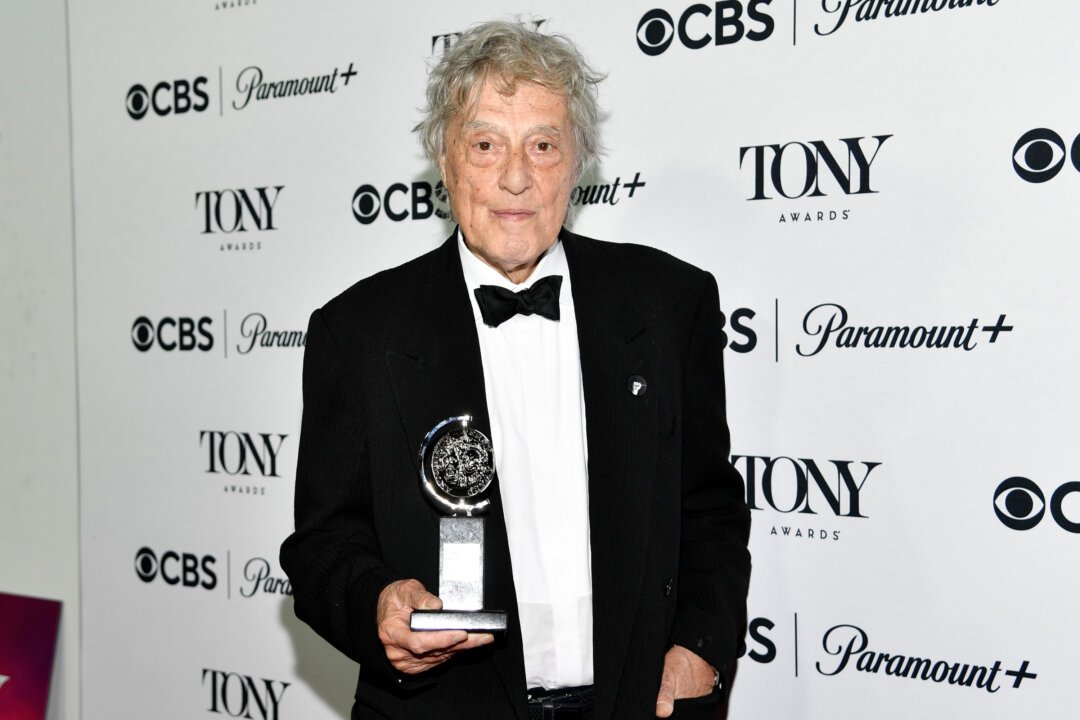
The theatrical world has lost one of its most brilliant voices with the passing of Sir Tom Stoppard, the celebrated British playwright whose intellectual wit and linguistic virtuosity captivated audiences for more than five decades. The Czech-born dramatist died peacefully at his home in Dorset, southwest England, on Saturday at age 88, surrounded by his family.

United Agents confirmed Stoppard’s death in a statement released Saturday, marking the end of an era for British theater. Widely regarded as the greatest British playwright of his generation, Stoppard leaves behind an extraordinary legacy that spans stage, screen, and radio, having redefined what theatrical storytelling could achieve.
Best known to mainstream audiences for his Academy Award-winning screenplay for the 1998 romantic comedy “Shakespeare in Love,” Stoppard’s influence extended far beyond Hollywood success. The film, which starred Gwyneth Paltrow and Joseph Fiennes, earned him an Oscar for Best Original Screenplay, cementing his reputation as a master storyteller capable of weaving historical fiction with contemporary sensibilities.
However, it was on the stage where Stoppard truly made his mark as a revolutionary force in modern drama. His breakthrough came with “Rosencrantz and Guildenstern Are Dead” in 1966, a brilliant reimagining of Hamlet told from the perspective of two minor characters. The play established his signature style of combining philosophical depth with playful wordplay, creating works that were both intellectually challenging and genuinely entertaining.
Throughout his illustrious career, Stoppard continued to push theatrical boundaries with works like “Jumpers,” “The Real Thing,” and “Arcadia,” each demonstrating his unique ability to blend complex ideas about science, philosophy, and human nature with compelling dramatic narratives. His plays often featured intricate plotting, dazzling dialogue, and characters grappling with questions of truth, reality, and meaning.
The playwright’s final major triumph came with “Leopoldstadt,” a deeply personal work that premiered in 2020 and earned him his fifth Tony Award in 2022. The play, which explores the fate of a Jewish family in Vienna across several decades, was widely considered his masterpiece and a profound meditation on memory, identity, and loss.
Born Tomáš Straussler in Czechoslovakia in 1937, Stoppard’s early life was marked by displacement and reinvention. His family fled the Nazi invasion when he was just two years old, eventually settling in England, where he would later adopt his stepfather’s surname and begin his journey into the world of letters.
Stoppard’s impact on contemporary theater cannot be overstated. He transformed British drama by proving that audiences hungered for intelligent, challenging work that didn’t sacrifice entertainment value for intellectual rigor. His influence can be seen in countless playwrights who followed, all attempting to match his rare combination of cerebral complexity and theatrical magic.
Beyond his creative achievements, Stoppard was known for his advocacy of human rights and his support for writers facing political persecution. He used his platform to speak out against authoritarianism and championed the cause of artistic freedom throughout his career.
As news of his passing spreads throughout the global theater community, tributes are pouring in from fellow writers, directors, and actors whose lives and careers were touched by his genius. Stoppard’s death marks not just the loss of a great playwright, but the end of a golden age in British theater that he helped define and elevate.
His complete body of work stands as a testament to the power of language, the importance of ideas, and the enduring magic of live theater. While Tom Stoppard may have taken his final bow, his words will continue to illuminate stages and inspire audiences for generations to come.