













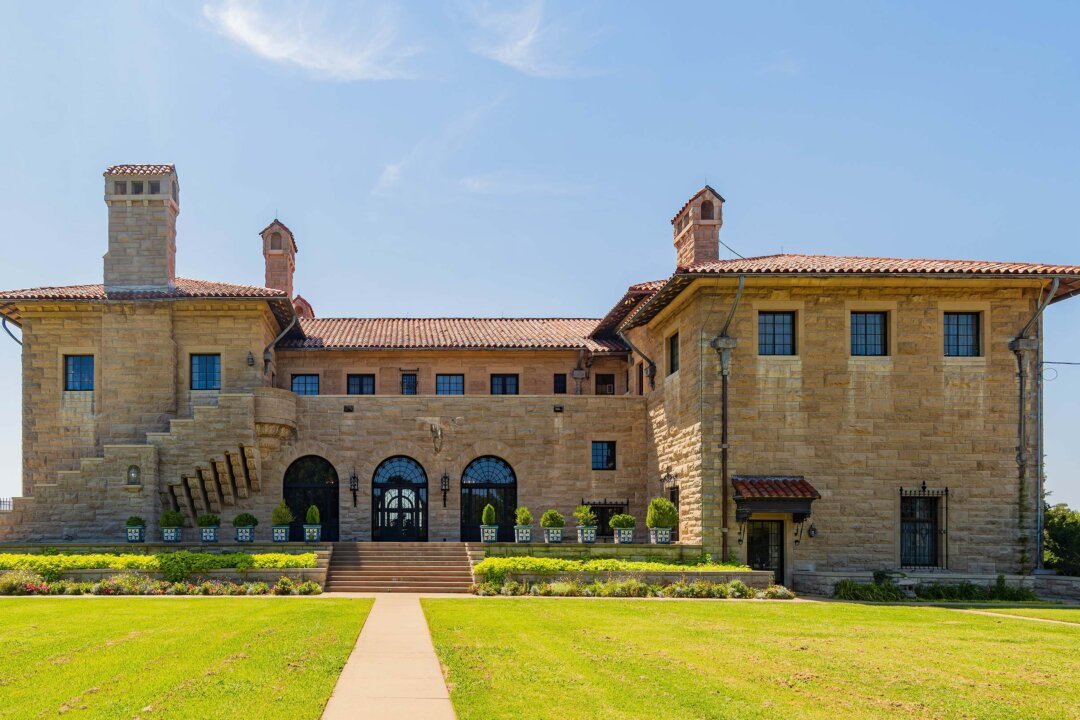
Deep in the heart of Oklahoma’s rolling prairie, where endless grasslands meet expansive skies, stands an architectural marvel that seems transported from Renaissance Italy. The E.W. Marland Mansion in Ponca City rises like a dream from the landscape, its 55 rooms sprawling across the countryside in a testament to one man’s extraordinary vision and boundless ambition.

This isn’t just another grand American home—it’s a full-scale Mediterranean Revival castle that faithfully recreates the architectural splendor of Tuscany. Modeled after Florence’s historic Davanzati Palace, the mansion showcases the meticulous work of skilled artisans and craftsmen from across the globe, each contributing their expertise to create what locals affectionately call the “Palace on the Prairie.”
The man behind this remarkable achievement was Ernest Whitworth Marland, a figure whose life story reads like an American epic. Marland first tried his luck as a wildcatter in Pennsylvania’s oil fields, where he experienced the intoxicating rush of striking it rich—followed by the devastating crash of losing everything. But this setback only fueled his determination.
Refusing to accept defeat, Marland packed up and headed west to Oklahoma’s promising oil territories. There, amid the red dirt and prairie winds, he struck black gold once again. This time, his success reached staggering heights. At the peak of America’s oil boom, Marland controlled an astounding one-tenth of the world’s entire oil production, making him one of the most powerful energy magnates of his era.
With such immense wealth and influence came the desire for a residence that would properly reflect his status. Marland didn’t simply want a large house—he envisioned a masterpiece that would stand as a monument to his achievements and serve as a cultural beacon in America’s heartland.
The resulting mansion is nothing short of spectacular. Constructed from rusticated limestone blocks quarried directly on the property, the structure maintains authentic Tuscan architectural principles throughout its design. The distinctive Italian Renaissance-style terra-cotta tile roof crowns the building, while dramatic balconies supported by massive stone corbels punctuate the facade, creating the visual rhythm characteristic of genuine Tuscan palazzos.
Every detail of the mansion speaks to Marland’s commitment to authenticity and excellence. The Mediterranean Revival style wasn’t merely borrowed—it was faithfully interpreted and executed with the kind of precision that would make Florentine architects proud. From the proportions of the rooms to the placement of windows and doors, the mansion honors the architectural traditions of Italy’s most celebrated region.
Today, the E.W. Marland Mansion stands as both a remarkable private residence and a significant piece of American architectural history. It represents a unique moment when oil wealth and cultural ambition combined to create something truly extraordinary on the American prairie. The mansion serves as a reminder that great architecture knows no geographical boundaries—that with vision, resources, and dedication, a slice of Renaissance Italy could flourish in the heart of Oklahoma.
In our ongoing exploration of “Larger Than Life: Architecture Through the Ages,” the Marland Mansion exemplifies how individual ambition and artistic vision can create lasting monuments that enrich our cultural landscape for generations to come.