













When times grow dark and uncertainty clouds the horizon, Americans have consistently turned to one enduring tradition that transcends hardship: Thanksgiving. This uniquely American holiday has weathered world wars, economic collapse, and countless personal struggles, proving that gratitude and community can flourish even in the most challenging circumstances.

Perhaps no image captures this resilience better than Norman Rockwell’s iconic painting “Freedom from Want.” When it graced the pages of The Saturday Evening Post in March 1943, America was deep in the throes of World War II. Families across the nation were separated by conflict, rationing had become a way of life, and uncertainty dominated daily existence. Yet Rockwell’s masterpiece—inspired by President Franklin Roosevelt’s 1941 State of the Union Address and part of his celebrated “Four Freedoms” series—presented an idealized vision of American thanksgiving that resonated deeply with a nation at war.
The painting has since become synonymous with American Thanksgiving itself, though most people simply know it as “the Thanksgiving painting.” Its enduring appeal lies not just in its artistic merit, but in its representation of an American ideal: that even in times of scarcity and struggle, we can find reasons to gather, share, and give thanks.
This tradition of celebrating Thanksgiving during difficult times stretches far beyond World War II. During the Great Depression of the 1930s, families across America faced unprecedented economic hardship. Unemployment reached staggering heights, breadlines formed in cities nationwide, and many families struggled to put food on the table. Yet Thanksgiving persisted, adapted to circumstances but never abandoned.
Depression-era Thanksgiving celebrations became exercises in creativity and resourcefulness. Families made do with whatever they could afford or grow themselves. Traditional turkey might be replaced with chicken, duck, or even rabbit. Side dishes consisted of whatever vegetables could be preserved from summer gardens or purchased with limited means. The holiday became less about abundance and more about appreciation for whatever blessings remained.
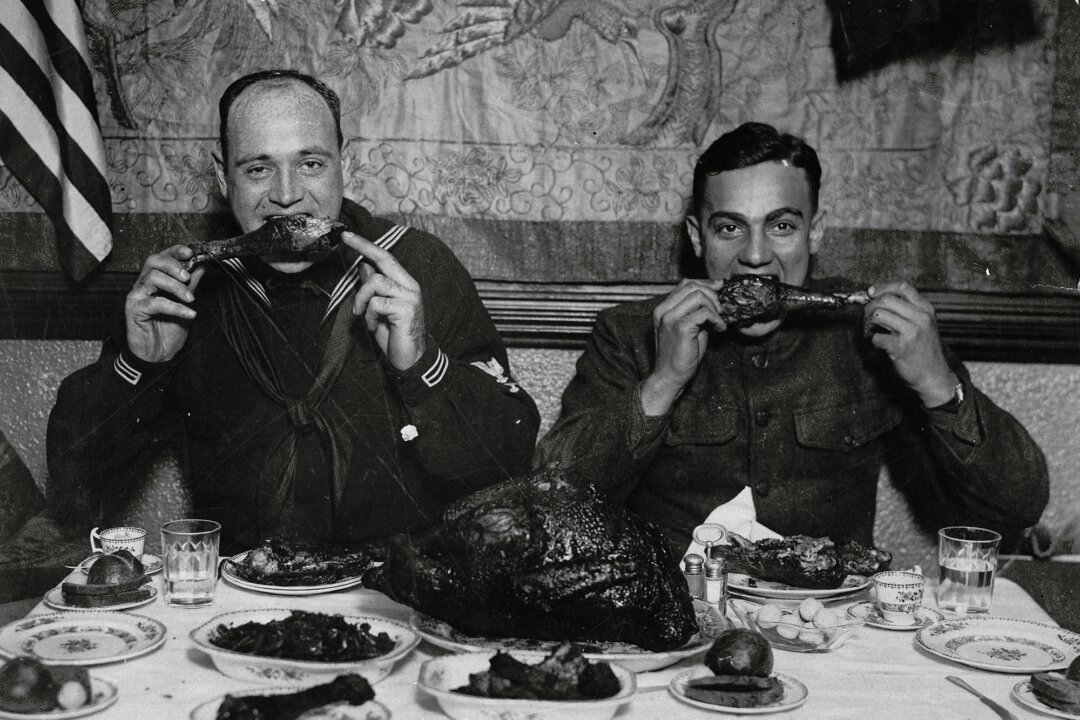
During World War II, Thanksgiving took on additional layers of meaning and complexity. Military families faced the holiday with empty chairs at the dinner table, while servicemen and women celebrated thousands of miles from home. Military commanders recognized the importance of maintaining morale and tradition, often going to extraordinary lengths to provide Thanksgiving meals for troops stationed around the globe.
Historical photographs from the era show servicemen enjoying Thanksgiving dinners in military mess halls from the Pacific Theater to European battlefields. These images reveal the same spirit of gratitude and community that Rockwell captured in his painting, though the setting and circumstances differed dramatically from the cozy domestic scene he portrayed.
The home front during wartime presented its own challenges for Thanksgiving celebrations. Rationing affected traditional holiday ingredients, forcing families to adapt recipes and expectations. Sugar shortages meant simpler desserts, meat rationing affected the main course, and many traditional holiday staples became luxury items. Yet families found ways to maintain the essence of the holiday while adapting to wartime realities.
These historical examples offer valuable lessons for contemporary celebrations. They demonstrate that Thanksgiving’s true meaning doesn’t depend on elaborate meals or perfect circumstances. Instead, the holiday’s power lies in its fundamental purpose: bringing people together to acknowledge their blessings and strengthen community bonds.
The resourcefulness displayed during the Depression era teaches us that creativity and adaptation can preserve tradition even when resources are limited. Families learned to focus on gratitude for what they had rather than lamenting what they lacked. This shift in perspective often resulted in more meaningful celebrations than those of more prosperous times.
Similarly, wartime Thanksgivings emphasized the importance of connection over consumption. Families separated by military service found ways to feel connected across vast distances, while communities came together to ensure that no one celebrated alone. These examples remind us that the holiday’s emotional and spiritual benefits don’t require material abundance.
Modern families facing their own challenges—whether economic uncertainty, health crises, or other hardships—can draw inspiration from these historical precedents. The lesson is clear: Thanksgiving adapts to circumstances while maintaining its essential character. Whether celebrated with a full traditional feast or a simple shared meal, the holiday’s power to foster gratitude and strengthen relationships remains constant.
The enduring popularity of Rockwell’s “Freedom from Want” speaks to Americans’ desire for stability and abundance, but the historical reality of Thanksgiving celebrations shows us something equally important. The holiday’s true strength lies not in perfect circumstances but in its ability to create meaning and connection regardless of external conditions.
As we approach another Thanksgiving, these historical lessons remind us that the holiday’s value transcends any particular menu or setting. Whether we’re celebrating with turkey and all the traditional trimmings or adapting to current circumstances, the fundamental purpose remains unchanged: coming together to acknowledge our blessings and strengthen the bonds that connect us to family, community, and shared American values.
The resilience demonstrated by previous generations during times of crisis offers both inspiration and practical guidance. Their examples show us that Thanksgiving can not only survive difficult times but can actually become more meaningful when we focus on its essential purpose rather than its superficial trappings.