













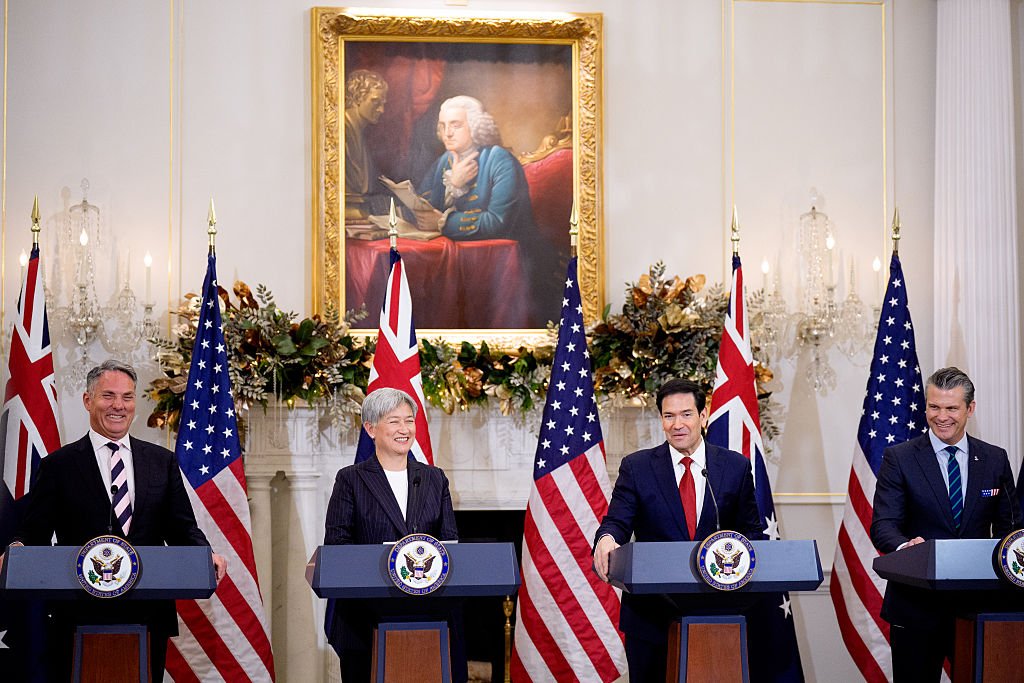
In a significant diplomatic development, senior officials from the United States and Australia have reinforced their commitment to the AUKUS security partnership, with both nations declaring each other as their strongest allies during high-level ministerial talks in Washington.

The reassurance came during the Australia-U.S. Ministerial Consultations (AUSMIN) meeting held on December 8, where Australian Foreign Minister Penny Wong and Defence Minister Richard Marles engaged in crucial discussions with newly appointed U.S. Secretary of State Marco Rubio and Defense Secretary Pete Hegseth at the State Department.
Speaking at a joint news conference, U.S. officials confirmed that the trilateral AUKUS agreement between Australia, the United Kingdom, and the United States remains at “full steam ahead,” signaling unwavering American support for the strategic partnership despite recent political transitions in Washington.
The timing of these assurances carries particular weight as the meeting marked one of the first major diplomatic engagements for the Trump administration’s new foreign policy team, effectively putting to rest any speculation about potential shifts in America’s Indo-Pacific strategy.
According to a statement released by Foreign Minister Wong on December 9, the AUSMIN discussions centered on three critical areas: maintaining regional stability across the Indo-Pacific theater, deepening the Australia-U.S. strategic alliance, and enhancing national security through expanded economic cooperation initiatives.
The Indo-Pacific region has emerged as a focal point of international attention, with both nations recognizing the area’s strategic importance for global trade routes and security architecture. The reaffirmation of AUKUS comes at a time when regional dynamics continue to evolve, making the partnership increasingly vital for maintaining balance and stability.
The AUKUS agreement, originally announced in September 2021, represents one of the most significant defense partnerships in recent decades. The pact focuses on sharing advanced defense technologies, with particular emphasis on nuclear-powered submarines for Australia’s naval capabilities, marking a historic shift in the region’s military landscape.
During the Washington meetings, officials from both countries emphasized the multifaceted nature of their relationship, extending beyond traditional defense cooperation to encompass economic security, technological innovation, and shared democratic values. This comprehensive approach reflects the evolving nature of modern international partnerships, where economic and security interests are increasingly intertwined.
The strong bilateral affirmations during AUSMIN underscore the enduring nature of the Australia-U.S. alliance, which has weathered numerous global challenges and political transitions over decades. Both Defense Minister Marles and Foreign Minister Wong’s presence in Washington for these inaugural discussions with the new U.S. administration demonstrates the priority both nations place on maintaining seamless diplomatic continuity.
For Australia, the renewed commitments provide crucial certainty for long-term defense planning and regional security strategies. The country has invested significantly in aligning its defense capabilities with AUKUS objectives, making American reassurance essential for maintaining momentum on key initiatives.
The economic cooperation dimension discussed during AUSMIN reflects growing recognition that national security in the 21st century encompasses supply chain resilience, critical mineral partnerships, and technological sovereignty. Both nations have identified these areas as crucial for maintaining their competitive advantages in an increasingly complex global environment.
As the AUKUS partnership moves forward with full American backing, the implications extend far beyond bilateral relations. The agreement serves as a cornerstone of broader Western strategy in the Indo-Pacific, influencing regional security calculations and alliance structures across the area.
The successful conclusion of these ministerial consultations sets a positive foundation for ongoing cooperation, with both countries now positioned to advance their shared objectives with renewed confidence and clear strategic direction.